
East Baton Rouge Parish Arrest Records and Charges
East Baton Rouge Parish arrest records begin on the law-enforcement and booking side. They may identify the person arrested, the agency involved, the booking path, the suspected arrest charge, and the custody channel. The East Baton Rouge Sheriff's Office operates parish jail custody through the East Baton Rouge Parish Prison and links a CentralSquare inmate portal for current custody. Over thirty law-enforcement agencies use the jail to book arrestees, so a booking entry is not always the same as the court charge eventually filed.
The court charge record begins after prosecutor review. In East Baton Rouge Parish, District Attorney Hillar C. Moore III's office serves the parish and the 19th Judicial Court. The DA may accept, reject, amend, reduce, divert, or prosecute charges. Once charges are filed, they become part of the criminal court record maintained by the court and Clerk of Court. For the full case file and final outcome, use East Baton Rouge Parish criminal court records; for current custody, jail search belongs with inmate records.
Search East Baton Rouge Parish Arrest Records
The arrest-to-charges search uses more than one channel. Current jail custody starts with the EBRSO inmate portal linked from the sheriff's official resources. Filed criminal charges start with ClerkConnect Criminal Inquiry for 19th JDC criminal cases. Police reports, incident reports, and sheriff public records that are not shown online use EBRSO's GovQA public-records portal. Traffic and city charges may use Baton Rouge City Court, Baker City Court, Zachary City Court, or 19th JDC Traffic depending on the issuing agency.
- Check whether the issue is a current custody question, a police-report request, or a filed criminal court charge.
- Use EBRSO custody channels for jail status and booking, but do not treat booking as a final court outcome.
- Use ClerkConnect Criminal Inquiry to search filed 19th JDC criminal charges by the fields shown in the live portal.
- Review the charge list, statute references, warrant entries, plea, disposition, and sentence before calling a charge a conviction.
- Use EBRSO GovQA for sheriff police reports and public records not available through the court portal.
The EBRSO GovQA public-records portal is the official request channel for sheriff reports and related public records.
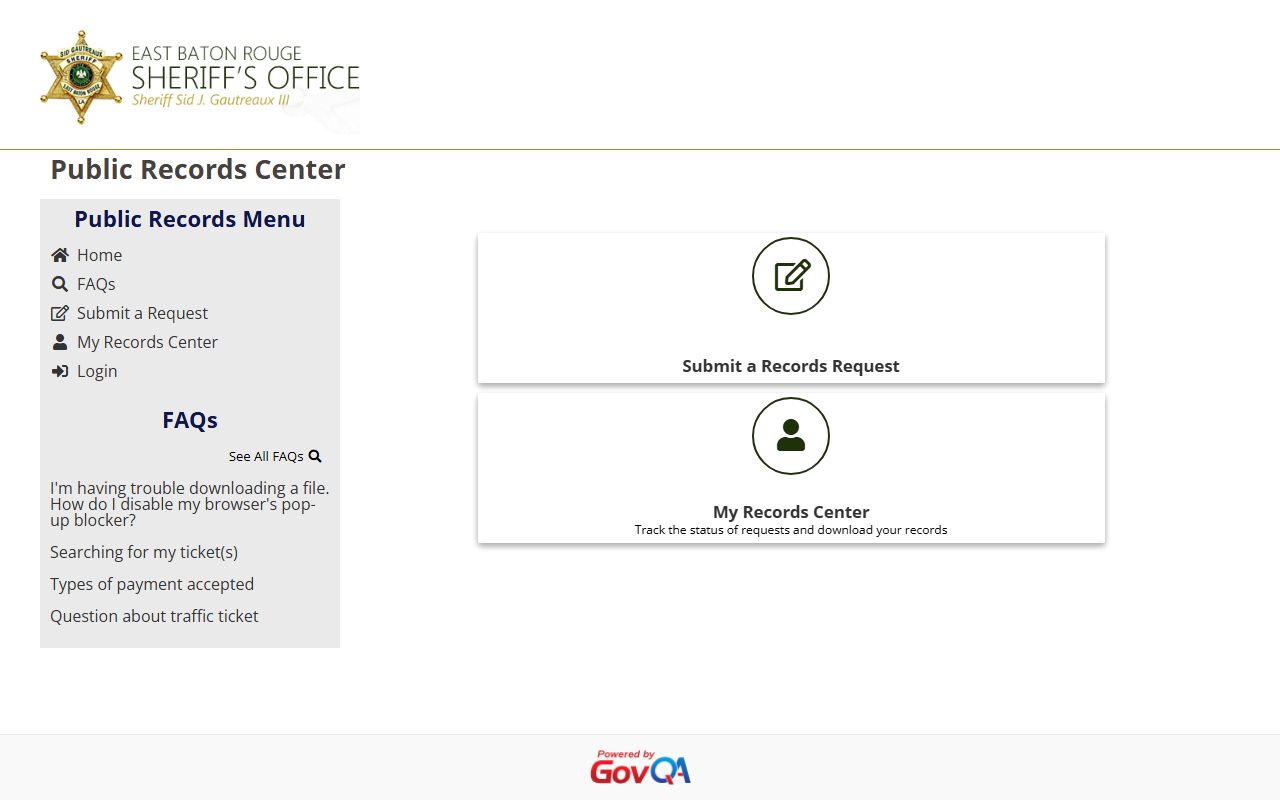
GovQA is useful for law-enforcement records, while filed charges and court outcomes remain court and clerk records.
Charges After Arrest in East Baton Rouge
Charges after arrest can enter court through different charging documents. A booking charge may reflect the officer's or agency's initial arrest basis. A court charge reflects a prosecutor's filing decision or a grand jury action. Louisiana criminal court records may refer to a bill of information, indictment, affidavit, warrant, minute entry, or other filing depending on the case stage. The filed document is important because it shapes arraignment, motions, plea, trial, disposition, and sentencing.
| Complaint / Affidavit | Bill of Information | Indictment | |
|---|---|---|---|
| Filed By | Law enforcement or prosecution support, depending record type. | Prosecutor. | Grand jury. |
| Common Use | Initial arrest, warrant, or probable-cause support. | Many prosecuted criminal charges. | Serious felony matters when grand jury action is used. |
| Record Role | Connects the arrest basis to the court file. | States the formal prosecuted charge. | States grand-jury charges in court. |
| What To Check | Arrest charge, affidavit facts, warrant, and booking link. | Filed offense, statute, amendments, and disposition. | Charge count, statute, arraignment, and later disposition. |
East Baton Rouge Charge Status
Charge status can change several times. A defendant can be arrested, booked, released on bond, charged by information, recharged by amendment, placed in diversion, have one count dismissed, plead to another count, or receive a sentence after conviction. The 19th JDC also has problem-solving and diversion-related programs, including Recovery Court, Re-Entry Court, Pretrial Diversion and Recovery, and Veterans Treatment Court. Those programs can affect how a charge moves through the court without making the original arrest record disappear.
| Status | What It Means |
|---|---|
| Pending | The charge remains open and has not reached final disposition. |
| Amended / Reduced | The prosecutor or court record changed the charge, often to a different count or lesser offense. |
| Dismissed | The court record shows the charge did not proceed to conviction in that form. |
| Nolle Prosequi | The prosecution declines to proceed on that charge, often shown as a dismissal-type entry. |
| Diversion / Program | The charge may be monitored through a court or DA program before final resolution. |
| Convicted / Sentenced | A plea or verdict led to sentencing, probation, fines, jail, prison, or other penalties. |
Note: One arrest can produce multiple charges, and each charge can have a different status or final result.
Charges vs Convictions
An arrest record or filed charge is not proof of conviction. East Baton Rouge Parish arrest records may show a booking event and suspected charge, while court charge records show what the DA filed and how the court handled each count. A conviction appears only after a valid guilty plea, verdict, or other court finding that supports sentencing. Dismissals, acquittals, reductions, diversion, and expungement can change what the public should infer from a charge line.
| Charge | Conviction | |
|---|---|---|
| Stage | Arrest, booking, or prosecution accusation. | Final guilt result by plea or verdict. |
| Where It Appears | Booking data, affidavits, bills of information, indictments, and docket entries. | Disposition, plea, verdict, sentencing, and probation records. |
| Meaning | Alleged offense or filed count. | Court outcome that supports punishment or supervision. |
| Best Check | Charge status and amendment history. | Disposition and sentence fields. |
Arrest Reports and Separate Records
Not every law-enforcement record is a court charge record. EBRSO links separate public-records, inmate, sex-offender, and crash-report resources. The BuyCrash/LexisNexis portal is for EBRSO crash reports and is separate from court charge lookup. The sheriff's public-records request process may be needed for incident or police reports. Those records can support an arrest or investigation, but the court file still controls formal charges, pleas, dispositions, and sentences.
The EBRSO BuyCrash report portal is an example of a sheriff-linked record channel that is not a criminal charge docket.
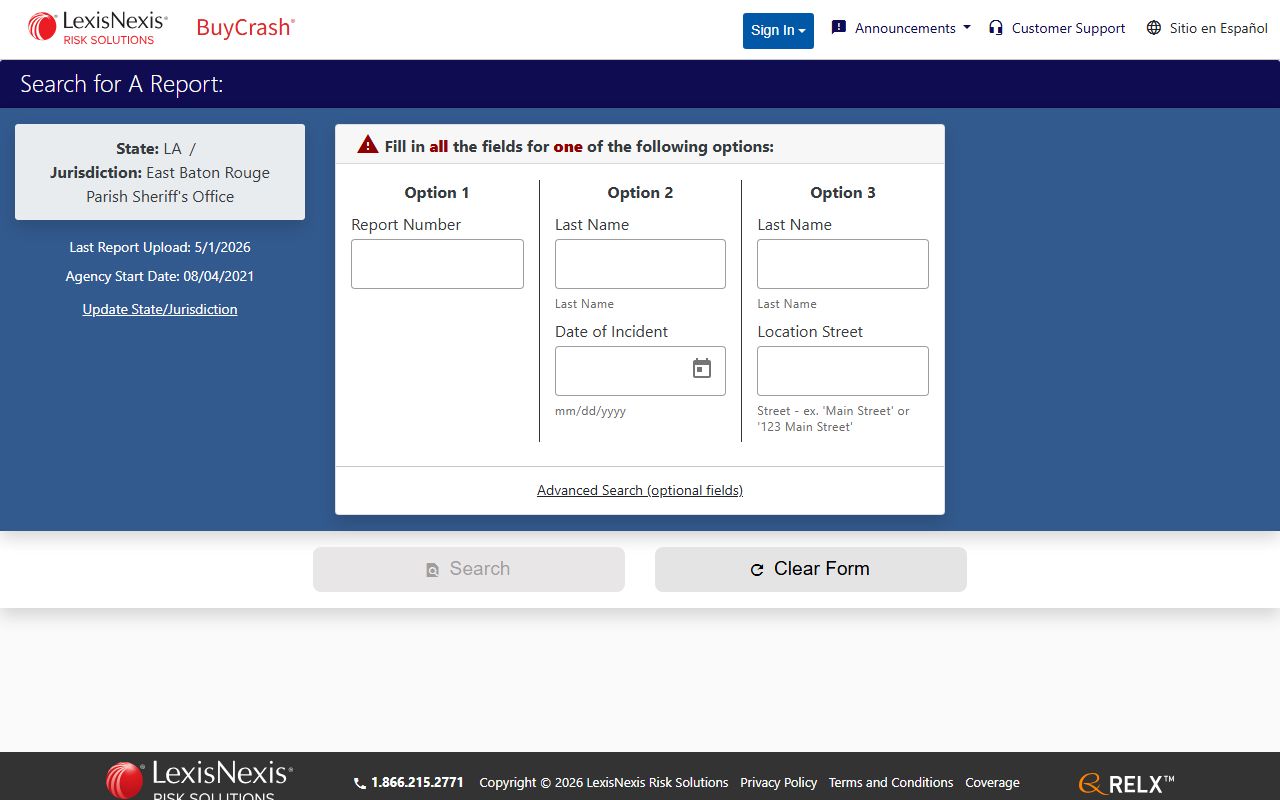
Separating crash, incident, booking, and court-charge records prevents a records search from mixing different custodians and legal meanings.
East Baton Rouge Charge Codes
Filed charge records may cite Louisiana statutes, local ordinances, traffic provisions, or other offense references. A felony charge in 19th JDC is different from a Baton Rouge City Court misdemeanor or a city traffic charge. Traffic records in East Baton Rouge also depend on the issuing agency: EBRSO, Louisiana State Police, LSU Police, Southern University Police, Baker City Police, Zachary City Police, and other listed agencies may route to 19th JDC Traffic, while Baton Rouge City Police tickets go to City Traffic Court.
Charge codes should be read with the docket. The same arrest can include multiple counts, and a later bill of information or indictment may use different wording than the booking record. If a charge was amended or reduced, the current filed charge and disposition matter more than the first booking label. If a warrant or capias appears, the status may relate to failure to appear, failure to comply, contempt, or an unresolved traffic or criminal obligation.
Public Access to Arrest and Charge Records
Louisiana public access starts with the principle that public documents are open unless law provides otherwise. Louisiana Constitution Article XII, Section 3 recognizes public access to public documents. Louisiana public-records statutes define public records and require custodians to permit inspection or copying during regular hours, subject to exceptions. For East Baton Rouge Parish arrest records, the custodian may be EBRSO or another law-enforcement agency. For filed court charges, the custodian is usually the court or Clerk of Court.
The Louisiana constitutional public-records source supports the access framework for court charges and related public records.
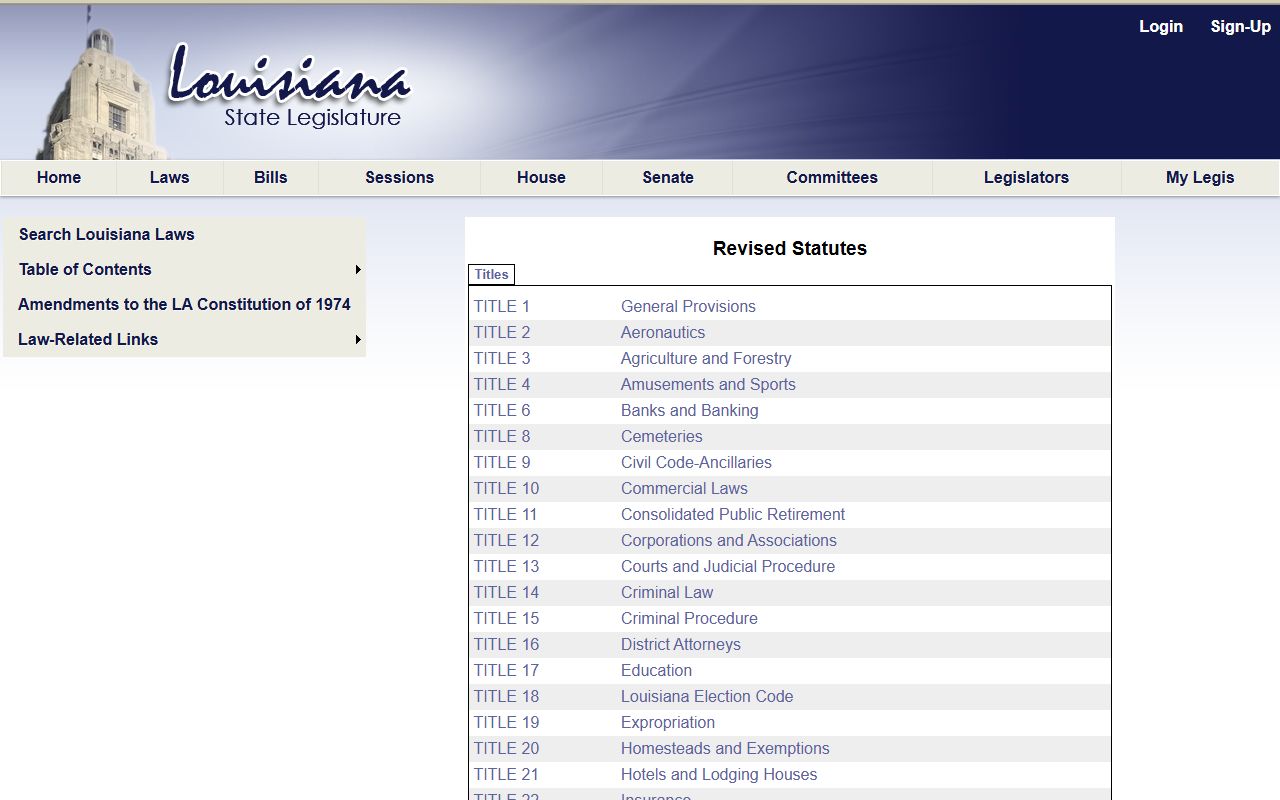
Access rights do not override juvenile confidentiality, expungement orders, sealed files, active-investigation limits, or protected personal data.
Sealed vs Expunged Charges
Sealed and expunged records limit public access in different ways. A sealed charge is hidden from ordinary public view because a statute or court order restricts it. An expunged arrest or conviction record is removed from public access after the court grants and processes an order, but Louisiana expungement does not destroy the record. Authorized courts, law enforcement, prosecutors, licensing agencies, or other entities may still have access depending on the law and order.
| Sealed | Expunged | |
|---|---|---|
| Public Search | Generally hidden or restricted. | Removed from public access after processing. |
| Record Status | Still exists under restricted access. | Still exists for authorized access, not destroyed. |
| Local Route | Depends on court order or confidentiality rule. | Clerk Criminal Records processes eligible 19th JDC expungements. |
| Common Limits | Juvenile, adoption, protective, or sensitive records. | Eligibility and service requirements under criminal procedure articles. |
Background Check Limits
Arrest records and court charges can be misunderstood when used outside their legal context. A booking entry may not become a filed charge. A filed charge may later be dismissed. A pending charge is not a conviction. An expunged record may be removed from public access even though authorized agencies can still see it. For employment, tenant, credit, insurance, and other regulated screening, use compliant consumer-reporting channels and verify records with the official custodian.
Important: Arrest and charge lookup results must not be used for FCRA-regulated decisions unless obtained through compliant screening channels.
Restricted East Baton Rouge Charge Records
Restricted charge records include juvenile matters, sealed charges, expunged arrests or convictions, active investigative records, protected victim or witness details, adoption-related filings, and mental-health information. Louisiana Children's Code article 412 generally protects juvenile court records and reports, except as authorized. Law-enforcement and prosecutive files can also have special limits while an investigation or prosecution is active. Public copies may redact Social Security numbers, financial account data, birth dates, minor names, addresses, or sensitive domestic violence information.
The practical check is custodian-specific. EBRSO handles sheriff records and jail custody. The Clerk handles filed 19th JDC criminal files. City Court, Baker, and Zachary handle their local charges. The DA's filing decision shapes what becomes a court charge. If an online search shows no record, the reason may be the wrong court, a pending booking intake, a sealed or expunged file, an older archive record, or a nonpublic juvenile matter.